
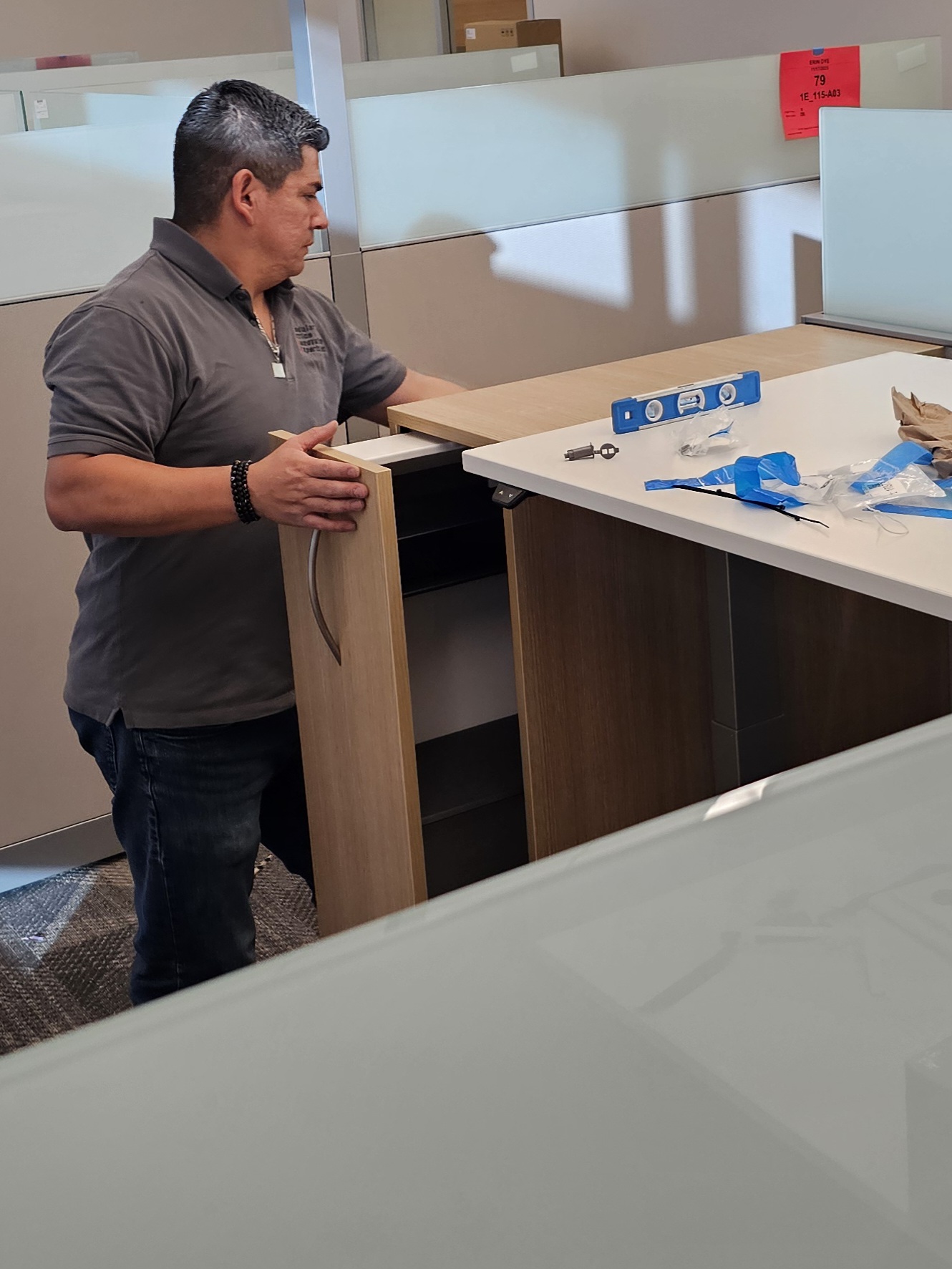
Floor plans look clean on paper. Then the furniture shows up and the real room has a column right where a workstation is supposed to go, a corner that is not quite square, or a wall that bows half an inch over twenty feet. Older Denver buildings especially tend to have their quirks.
When standard furniture does not quite fit, the first instinct is often to order a custom piece from the manufacturer. Sometimes that is the right call. A lot of the time, though, the better answer is a field modification: adjusting the standard product on site so it fits the space you actually have.
What a field modification is
A field modification is work done on site, by an installer, to make a standard product fit a non-standard condition. It is not a hack or a workaround. Done right, it should look like it came that way from the factory.
Common examples include:
- Notching a work surface to wrap around a building column
- Trimming a panel or desktop to fit a tight run between two walls
- Scribing an edge so it sits tight against a wall that is not straight
- Adjusting pieces so two different furniture lines connect cleanly
Scribing to uneven walls
Very few walls are perfectly flat. Drywall over old framing, plaster in older buildings, and windowsills that drift a little out of level are all normal. When a straight-edged work surface or panel meets a wavy wall, you get a gap. Sometimes it is small, sometimes it is wide enough to lose a pen in.
Scribing is the process of tracing the actual profile of the wall onto the edge of the piece and then cutting to that line. The result is a tight fit that follows the wall instead of fighting it. It is a small detail, but it is one of the things people notice when a space feels finished.
Trimming around columns and odd corners
Columns are the classic problem. A row of workstations is laid out on a nice grid, and then a structural column lands right in the middle of someone’s desk. Moving the whole row usually throws off everything else.
Trimming and notching lets us cut work surfaces and panels so they fit around the column and keep the layout intact. The same approach works for angled corners, short runs and other spots where the standard size is just a little too big.
These are the kinds of areas that often become dead space. With a few careful cuts, they turn into usable workstations or storage instead.
Why edge-banding matters
Any time a laminate or veneer surface is cut, the raw core underneath is exposed. Left that way, it looks unfinished and can chip or take on moisture over time.
Edge-banding seals that cut edge with a finish that matches the rest of the piece. This is the step that separates a modification that looks professional from one that looks like someone took a saw to it. We treat the finish on every cut, edge-band and joint as part of the job, not an afterthought.
Field mods vs. custom factory orders
Custom factory pieces have their place, but they come with trade-offs.
Lead time. Custom orders often carry long lead times. If your project has a move-in date or a year-end deadline, waiting on one odd-sized piece can hold up the whole job.
Cost. Custom work from a manufacturer typically costs more than a standard piece. Modifying standard product in the field can get you the same fit for less.
Accuracy. A custom order is built from measurements taken before install. If the measurement is off, or the wall is different than the drawing, you find out when the piece arrives. A field modification is fit to the real condition, on site.
Field modifications also come up a lot when companies reuse furniture they already own in a new layout or a new space. Pieces that fit the old office perfectly may need a little adjustment to work in the new one. That is often a far better deal than replacing them, which we covered in move, reconfigure, or buy new.
Blending different furniture lines
Another common situation: a company has furniture from more than one manufacturer, maybe from an acquisition, a past move, or a few rounds of buying over the years. The pieces were never designed to connect.
Our technicians can often adapt hardware and modify components so different lines work together as one layout. It is not always possible, and we will be straight with you when it is not, but it is worth asking before you assume you need to replace everything. The same goes for demountable walls from different systems.
When a field mod is not the right answer
Not every problem should be solved with a saw. If a modification would void a manufacturer warranty, affect structural integrity, or create an egress or code issue, a different approach is the better choice. Part of our job is telling you when that is the case.
Got a spot that doesn’t fit?
If you have a column, a crooked wall or an awkward corner that is holding up your layout, we are happy to come take a look. You can see more about this work on our custom modifications page.
Call 303.371.4049 or send us a message.